
What Are AI SOAP Notes for Veterinarians? Pros, Cons & How They Work
Last Updated: May 25, 2026
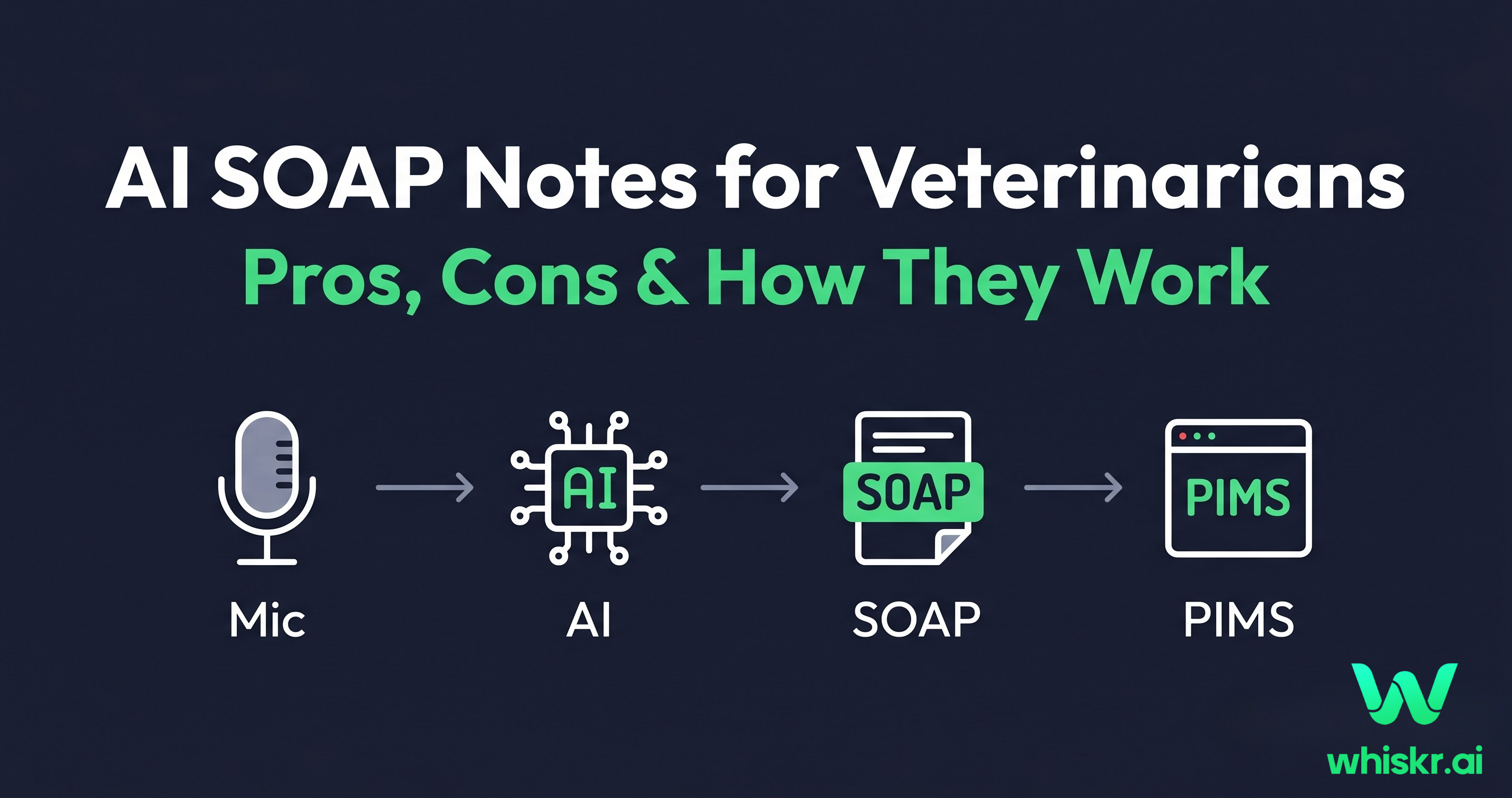
AI SOAP notes are structured Subjective–Objective–Assessment–Plan records automatically generated from a veterinary consult. An ambient AI scribe captures the exam conversation, transcribes it, and drafts a SOAP-formatted note for the DVM to review and finalize — typically in 1 to 3 minutes instead of 10 to 18 minutes of manual typing.
By turning spoken clinical reasoning into standardized documentation in real time, AI SOAP notes free veterinarians from after-hours charting and allow more face-to-face attention during the exam. The SOAP framework remains the gold standard for veterinary medical records; AI handles the mechanical structuring so you stay focused on the patient.
| Section | What AI captures |
|---|---|
| S — Subjective | Owner history, chief complaint, reported symptoms |
| O — Objective | Vitals, exam findings, in-house lab results |
| A — Assessment | Diagnosis, differentials, clinical reasoning |
| P — Plan | Medications, diagnostics, client instructions, follow-up |
How AI SOAP notes work
- Record during the consult. Speak naturally with the client. No dictation syntax — the scribe captures the conversation via microphone or mobile app.
- Transcribe and classify. Speech-to-text converts audio to text while separating DVM clinical observations from owner history (speaker diarization).
- Draft structured SOAP. A veterinary-trained language model organizes content into Subjective, Objective, Assessment, and Plan — with species, breed, and drug terminology handled correctly.
- Review and finalize. The draft appears for your validation. Edit any section, apply clinical judgment, and sync to your PIMS. You retain full responsibility for every record.
With whiskr.ai, powered by Atlas AI, most veterinarians complete review and finalize in under a minute per section — before the next patient.
AI SOAP notes vs dictation vs manual typing
Dictation still requires you to narrate the entire note or correct a raw transcript afterward. Manual typing pulls your attention to the keyboard during or after the visit. AI SOAP tools listen passively, summarize automatically, and output a structured draft ready for review.
| Dimension | Manual SOAP | Dictation | AI SOAP (vet scribe) |
|---|---|---|---|
| Creation method | Typing in PIMS | Voice-to-text narration | Ambient capture + LLM structuring |
| Average time per note | 10–18 min | 7–12 min | 1–3 min review |
| When documentation happens | Often after hours | During or after visit | During visit |
| Structure consistency | Varies by clinician | Varies by clinician | Model-level SOAP formatting |
| Vet terminology | Depends on individual | Depends on individual | Vet-trained (e.g., Atlas 98% accuracy) |
| PIMS integration | Manual entry | Often copy-paste | One-click sync (EzyVet, NectarVet, Neo) |
| Impact on burnout | Neutral or negative | Mixed | Burnout decreased 51.9% → 38.8% in physician ambient scribe study |
Human medicine study; veterinary-specific ambient scribe research is emerging, but early vet adoption shows the same workflow pattern.
Benefits of AI-generated SOAP notes in veterinary practice
1. More time for patients and clients
When you are not typing during the exam, you observe behavior, palpate more thoroughly, and listen to owner concerns. AI handles the record; you handle the medicine.
2. Same-day note closure
Notes finished during the visit mean less pajama time — the after-hours charting that drives burnout. A 2024 quality improvement study found ambient scribes improved same-day appointment closure by 9.3%.
3. Consistent structure across the team
Every associate produces SOAP notes in the same format. Handoffs, referrals, and rechecks are easier when records follow a predictable structure.
4. More complete Objective sections
Fatigue leads to abbreviated exam documentation. AI captures details you mention aloud — including relevant negatives — that might get dropped when rushing.
5. Veterinary-specific intelligence
Generic transcription misses breed names, drug names, and species-specific context. A vet-trained scribe like Atlas AI handles breed-aware vitals, 17+ languages for bilingual exams, and speaker diarization (DVM findings vs. owner history).
6. PIMS-ready output
Documentation only saves time if it reaches the medical record without re-entry. One-click sync with EzyVet, NectarVet, and IDEXX Neo eliminates copy-paste friction.
Pros and cons of AI SOAP notes
| Pros | Cons |
|---|---|
| Saves 8+ minutes per visit on average | Learning curve — most vets need 1–2 weeks to trust the output |
| Consistent SOAP structure every time | Review is mandatory — AI drafts, DVM owns the final record |
| Captures more detail than rushed manual notes | PIMS integration varies by vendor and practice setup |
| Reduces after-hours documentation | Not a diagnostic tool — Assessment and Plan require your clinical judgment |
| Scales across associates without retraining on templates | Occasional transcription errors require correction |
No silver bullet — but for most busy practices, the time recovered far outweighs the trade-offs.
Challenges with manual veterinary SOAP notes
Manual charting fails in predictable ways:
- Time-consuming — typing after every appointment steals hours that could go to patient care or revenue-producing visits.
- Memory decay — notes written hours later are thinner and less accurate than those captured during the consult.
- Workflow disruption — toggling between exam, PIMS, and templates breaks focus and lengthens visits.
- Documentation debt — deferred notes accumulate faster than they can be cleared.
- Medicolegal risk — incomplete or delayed records are harder to defend.
For the full data on documentation time, revenue impact, and burnout, see how much time vets waste on charting.
Veterinary use cases for AI SOAP notes
| Setting | Example visit | AI outcome |
|---|---|---|
| General practice | Annual dog wellness | Normal-finding template + vaccines and Plan auto-structured |
| Sick visit | Vomiting cat | Captures HPI, exam findings, differentials, treatment plan |
| Emergency | GDV triage | Fast structured note under time pressure |
| Multi-pet household | Two cats, same appointment | Separate SOAP per patient from one conversation |
| Bilingual consult | Spanish-speaking owner | English SOAP from mixed-language exam |
| Recheck | Post-op lameness follow-up | Progress documented with comparison to prior visit |
How to choose a veterinary AI SOAP tool
Not every AI scribe is built for veterinary medicine. Human-health tools (ambient scribes designed for primary care or behavioral health) often miss vet terminology, species context, and PIMS workflows.
Use this checklist:
- Veterinary-specific training — Does the model understand breeds, drugs, procedures, and species-specific anatomy?
- Review workflow — Can you edit every section before finalizing? Do you retain full clinical control?
- Speaker diarization — Does it separate your clinical findings from owner history into the correct SOAP sections?
- PIMS integration — Does it sync with your practice management system, or require copy-paste every time?
- Multilingual support — Can it handle bilingual exams if your client base requires it?
- Privacy — Are your records used for AI training? What are data retention policies?
- Clinical suggestions — Does it support (not replace) your reasoning with differentials or gap detection?
- Trial in your clinic — Can you test on real caseload before committing?
whiskr.ai checks these boxes for veterinary medicine: Atlas AI at 98% vet terminology accuracy, breed-aware vitals, PIMS sync, 17+ languages, and records never used for AI training. Other vet-focused tools exist (e.g., CoVet); the best choice is the one that fits your workflow after a real-world trial.
Example: AI-generated veterinary SOAP note
Below is an example of a sick-visit SOAP note after DVM review — the kind of output a veterinary AI scribe produces from a recorded consult.
Patient: Luna, 9 yo FS DSH
Visit type: Sick — vomiting
Provider: Dr. Smith, DVM
Subjective: 2-day history of decreased appetite and vomiting (~3×/day). Owner reports lethargy; no known toxin access. Indoor only. No prior similar episodes.
Objective: BCS 4/9, wt 4.1 kg (down from 4.5 kg in Jan). T 102.2°F, HR 180, mildly dehydrated (~5%). Quiet but responsive. Mild abdominal discomfort on palpation; no masses palpated. CBC/chem pending.
Assessment: Acute vomiting with mild dehydration — differential includes dietary indiscretion, gastroenteritis, pancreatitis, metabolic disease; rule out obstruction if not improving.
Plan: SQ fluids 100 mL; Cerenia 1 mg/kg SQ. Withhold food 12 hr then bland diet. Owner instructed on vomiting monitoring and red flags. Recheck in 48 hr or sooner if worsening; consider imaging if no improvement.
For more examples and section-by-section guidance, see our complete veterinary SOAP notes guide.
Best practices for getting started with AI SOAP notes
Start as a scribe, not an author
Use AI output strictly as a first draft. Review every section — especially Objective vitals, Assessment differentials, and Plan doses — before signing.
Verify the owner's voice in Subjective
Ensure client-reported history is accurately captured and not misattributed to your clinical observations.
Own your clinical reasoning
The AI may suggest an Assessment and Plan. You must evaluate and personalize based on your exam, experience, and the individual patient.
Run a parallel trial
For the first 1–2 weeks, compare AI drafts to your usual notes. Measure time saved and completeness — not just speed.
Train the whole team
Associates, relief vets, and locums benefit from the same workflow. Standardize on review-and-finalize so records stay consistent.
Monitor and adjust
Track note completion lag, editing time, and team feedback during the first month. Tune your workflow if review takes more than 3 minutes per note on average.
AI SOAP notes vs ChatGPT
ChatGPT can draft text from a prompt, but it is not built for live veterinary workflow:
- No exam recording or ambient capture
- No breed-specific vital interpretation
- No speaker diarization (DVM vs. owner)
- No PIMS sync — copy-paste every time
- No guarantee of veterinary terminology accuracy
- General models may hallucinate drug names or doses
A veterinary AI scribe like whiskr.ai's Atlas AI is designed for SOAP structure, clinical language, review-before-finalize workflows, and records never used for AI training.
Privacy and data handling
Veterinary medical records contain sensitive client and patient information. When evaluating AI SOAP tools:
- Confirm encryption in transit and at rest
- Ask whether patient data is used for model training (whiskr.ai: never)
- Understand data retention and deletion policies
- Ensure your team follows practice policies for recording consent where required
Stop typing. Start reviewing.
AI SOAP notes are not a gadget — they are a practical way to reclaim hours, produce clearer documentation, and put focus back on the patient in front of you.
Start your 14-day free trial — whiskr.ai records your exam, drafts structured SOAP notes with Atlas AI, and lets you review and sync to your PIMS before your next patient. No credit card required for the trial; 30-day money-back guarantee.
Related reading: What are veterinary SOAP notes? Complete guide + examples · How much time do vets waste on charting? · Pricing and ROI calculator